
Integrity
Public office is a public trust. Elected representatives and municipal officials must act honestly, ethically and in the interests of the communities they serve.
Across the country, too many municipalities face challenges including deteriorating infrastructure, unreliable service delivery, poor financial management, corruption, unemployment and declining public confidence.
Read Our Policy Priorities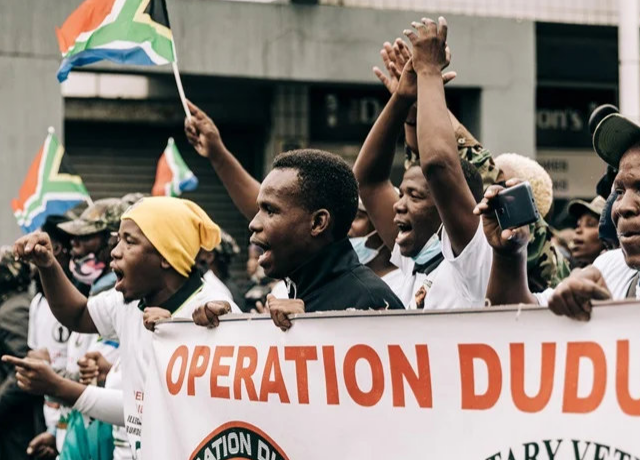

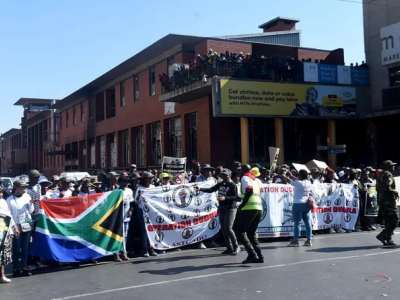
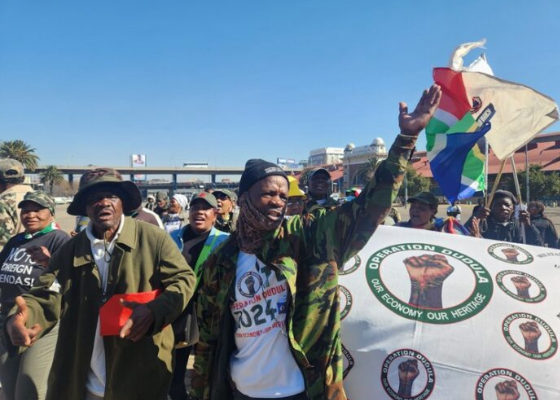
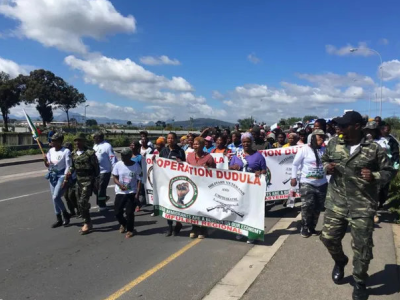
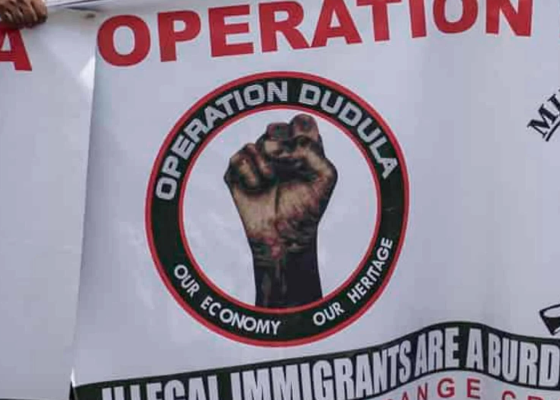
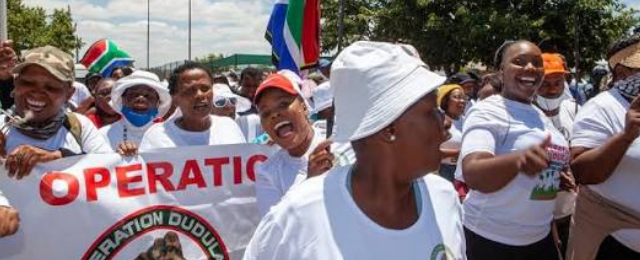
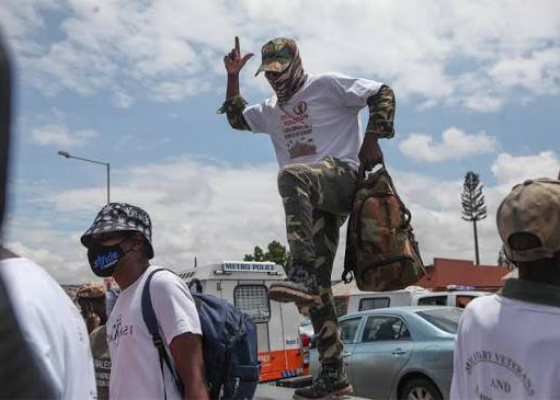
Operation Dudula started as a civic community movement in 2023, rising from the desperate cries of South African community members. It raised the issue of illegal migration through peaceful demonstrations, memorandums and marches to the Union Buildings. In the movement's view, these concerns were ignored or dismissed, and it decided to become a political party to effect change from within.
The President names illegal immigration, enabled by corruption and a lack of political will, as a pressing national issue, and commits the party to honest, balanced and lawful solutions, effective border management and a well-regulated immigration system. The party also pledges to address illegal mining, drug dealing, cash-in-transit heists, kidnapping, business hijacking and property hijacking.
Vision, Mission & ValuesTo build municipalities that are safe, lawful, prosperous, transparent and responsive, where every resident receives quality municipal services and where local government serves the people with integrity, accountability and respect.
To restore confidence in local government through ethical leadership, sound financial management, community participation and practical solutions that improve the daily lives of residents. Municipalities exist to serve communities and not political interests.
Public office is a public trust. Elected representatives and municipal officials must act honestly, ethically and in the interests of the communities they serve.
Residents deserve efficient municipal services. Local government must prioritise reliable basic services, functioning infrastructure and responsive administration.
Government decisions should be open to public scrutiny. Residents have a right to understand how decisions are made, how public money is spent and how performance is measured.
Government cannot succeed without active communities. Residents should have meaningful opportunities to participate in decisions affecting their communities.
Local government must operate within the law. Operation Dudula commits itself to operating within the Constitution and all applicable laws of the Republic of South Africa.
Local government should return to its constitutional purpose: delivering basic services, maintaining public infrastructure, supporting local economic growth, creating safe communities, managing public finances responsibly and working in partnership with residents.
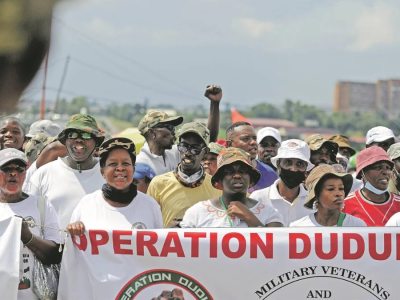
Illegal immigration remains a central mission of Operation Dudula. Immigration compliance, within the lawful powers of local government, will be a particular focus. The manifesto cites the Immigration Act 13 of 2002 (sections 2, 38, 39, 42 and 43) and the Refugees Regulations to argue that municipalities should not remain passive, while stating that municipalities will not determine immigration or refugee status themselves.
The Local Government Principle: immigration policy may be determined nationally, but the consequences of migration are experienced locally.
Safety is a foundation of a successful municipality and cannot be left to the police alone. Safety measures will be pursued within the Constitution and the law.
A service-delivery-first municipality built on five principles: Reliability. Accountability. Maintenance. Responsiveness. Consequence.
Municipal economic development must create opportunities for South Africans, particularly local residents, while building productive, lawful and sustainable local economies.
The right to housing is enshrined in Chapter 2 of the Constitution. The manifesto cites Stats SA's General Household Survey 2024, which puts informal dwellings at about 11.7% of households. The long-term objective is the complete eradication of informal settlements through formal housing and integrated communities.
Operation Dudula intends on building Orderly, Lawful and Sustainable Communities.
Clean government begins with clean communities. Environmental health will be strengthened within the municipality's lawful mandate through inspections, food-premises monitoring, action on illegal dumping, better sanitation and drainage, pollution monitoring and public reporting of major environmental health risks.
Within the first 100 days, an Operation Dudula municipality will begin a structured assessment of:
The findings will be presented to residents. The first responsibility of a new administration is to know what it has inherited.
Audit finances. Establish infrastructure baselines. Address critical service failures. Review contracts and procurement. Establish public performance reporting.
Accelerate maintenance. Address water, electricity, roads and waste backlogs. Improve revenue systems. Strengthen professional administration.
Expand economic development. Unlock municipal land. Increase local procurement. Expand housing and settlement upgrading. Increase youth opportunity.
Larger spatial-development projects. Expand economic corridors. Improve township-rural-CBD connectivity. Strengthen digital government. Attract investment.
Measure outcomes against the baseline. Publish what was and wasn't achieved, and why. Set out the remaining work.
At the beginning of our term, we will establish measurable baselines and report publicly at regular intervals on:

The full Operation Dudula Local Government Election Manifesto 2026, including the full text of Policy Priority One and its legal references.
That we will know what belongs to us. That we will take responsibility for it. That we will tell residents when something does not belong to us, and pursue the authority responsible. That we will publish what we are doing and measure whether it worked. And that we will not ask residents to accept a broken municipality as the normal price of government.